Introduction
Understanding Payroll Card Pros And Cons is essential in today’s modern workplace. As businesses move away from paper checks and traditional payment systems, payroll cards have become a popular alternative. A payroll card is a prepaid card issued by an employer to pay wages electronically. Instead of receiving a check or direct deposit into a bank account, employees get their salary loaded onto this card each payday.
Discussing Payroll Card Pros And Cons is important because this payment method affects both employees and employers. For workers without bank accounts, payroll cards can provide financial access and convenience. For businesses, they can reduce payroll processing costs and improve efficiency. However, payroll cards also come with potential drawbacks, including fees, usage limits, and compliance requirements. This guide will explain how payroll cards work, compare them to other payroll methods, explore their advantages and disadvantages, and help you decide whether they are the right choice for your organization or personal financial needs.
What Is a Payroll Card?
A payroll card is a type of prepaid debit card that employers use to pay employees. Instead of transferring money into a bank account, the employer loads wages directly onto the card each pay period. Employees can then use the card to make purchases, withdraw cash from ATMs, or pay bills online.
Payroll cards work similarly to regular debit cards. They are usually issued by major payment networks like Visa or Mastercard and can be used wherever those cards are accepted. On payday, the employer transfers the employee’s net wages to the card electronically. The employee can check their balance through an ATM, mobile app, or online portal.
Payroll cards are especially useful for unbanked or underbanked employees individuals who do not have traditional bank accounts. Industries such as retail, hospitality, construction, and seasonal employment often use payroll cards. Gig workers and temporary staff may also benefit from this payment method because it allows quick and simple access to wages without needing a bank account. While payroll cards offer convenience, it is crucial to understand the Payroll Card Pros And Cons before choosing this option.
How Payroll Cards Compare to Other Payroll Methods?
When evaluating Payroll Card Pros And Cons, it helps to compare payroll cards with other common payroll methods.
Direct deposit is the most popular payment method today. It transfers wages directly into an employee’s bank account. It is secure, convenient, and typically free. However, it requires the employee to have a bank account.
Paper checks are traditional and widely accepted. However, they can be lost, delayed, or stolen. Employees may also need to pay check-cashing fees if they do not have a bank account.
Cash payments are simple but risky. They lack documentation and can create compliance issues for employers.
Mobile wallets and digital payment apps are becoming more common, but they may not be accepted everywhere and often require linking to a bank account.
Online banking provides complete financial management, savings options, and bill payment services, but again requires an account.Below is a simple comparison table:
| Payroll Method | Bank Account Required | Fees Risk | Speed | Security Level |
| Payroll Card | No | Medium | Fast | High |
| Direct Deposit | Yes | Low | Fast | Very High |
| Paper Check | No | High | Medium | Medium |
| Cash | No | Low | Immediate | Low |
| Mobile Wallet | Usually Yes | Medium | Fast | High |
This comparison shows why understanding Payroll Card Pros And Cons is essential before deciding.
Payroll Card Pros (Advantages)
Benefits for Employees
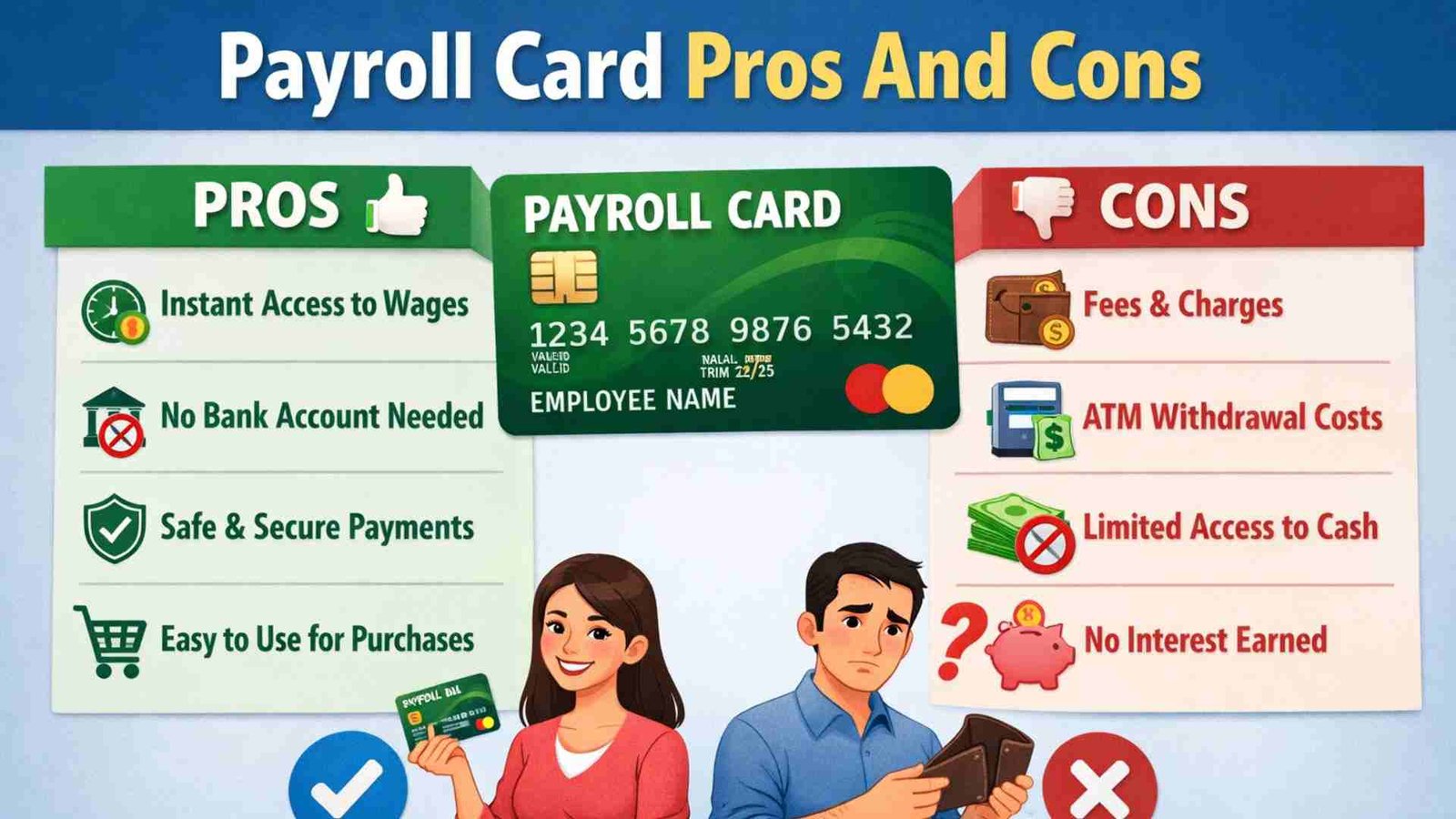
One of the biggest advantages in the Payroll Card Pros And Cons discussion is accessibility. Employees without bank accounts can receive wages electronically without needing traditional banking services. This promotes financial inclusion and reduces reliance on costly check-cashing services.
Payroll cards also provide convenient and fast access to funds. On payday, wages are available immediately. There is no waiting period like with mailed checks.Security is another benefit. Payroll cards are safer than carrying large amounts of cash. They require a PIN for transactions and often include fraud protection. If the card is lost or stolen, it can usually be replaced.
Transactions are trackable, allowing employees to monitor spending through online portals or mobile apps. This feature helps with budgeting and financial awareness.Additionally, payroll cards may reduce check-cashing fees. Instead of paying high fees at a check-cashing store, employees can withdraw funds directly from the card, sometimes for free within a specific ATM network.
Benefits for Employers
From an employer’s perspective, payroll cards can be cost-effective. Businesses save money on printing, mailing, and handling paper checks.Payroll processing becomes more streamlined because wages can be loaded in bulk electronically. This reduces administrative work and errors.
Payroll cards also promote inclusivity. Employers can ensure that all employees regardless of banking status receive timely and secure payment.When properly managed and alternatives like direct deposit are offered, payroll cards can support compliance with wage payment laws.
Payroll Card Cons (Disadvantages)
Drawbacks for Employees
When analyzing Payroll Card Pros And Cons, it is equally important to understand the disadvantages. One major issue is fees. Payroll cards may include ATM withdrawal fees, balance inquiry fees, monthly maintenance fees, or inactivity charges.Some cards have daily withdrawal limits or limited ATM access. Employees might have to travel to specific ATMs to avoid extra fees.
Unlike traditional bank accounts, payroll cards usually do not earn interest. This means employees cannot grow savings through interest earnings.Merchant acceptance can sometimes be limited, especially for online purchases or recurring payments.Complex terms and conditions can confuse users. If employees do not understand the fee structure, they may accidentally pay unnecessary charges.If the card is lost or stolen and not reported quickly, access to funds may be temporarily restricted.
Employer Challenges
Employers may face confusing fee structures from card providers. Selecting the wrong provider can harm employee satisfaction.Legal compliance is another concern. Employers must ensure that payroll cards are optional and that alternatives like direct deposit or checks are available.Finally, employee education is essential. Without proper training, workers may not understand how to avoid fees, leading to frustration.
Hidden Fees Explained
Hidden fees are one of the most discussed points in Payroll Card Pros And Cons. Common fees include ATM withdrawal charges outside the approved network, balance inquiry fees at ATMs, replacement card fees, and inactivity fees if the card is not used for a certain period.
For example, if an employee withdraws cash three times per week from an out-of-network ATM, they might pay a small fee each time. Over months, these charges can add up significantly.To avoid unnecessary fees, employees should use in-network ATMs, review the fee schedule carefully, and track transactions online instead of checking balances at ATMs. Employers should clearly explain these fees during onboarding.
Legal & Compliance Considerations
Understanding legal protections is critical when evaluating Payroll Card Pros And Cons. In the United States, payroll cards are generally covered under the Electronic Fund Transfer Act and Regulation E, which provide protections against unauthorized transactions.
Employers must offer payroll cards as an option, not a requirement. Employees should have the choice of receiving wages via direct deposit or paper check.Some states have additional regulations limiting fees or requiring clear disclosure of terms. Employers must ensure compliance with both federal and state laws to avoid penalties.Proper disclosure, transparency, and voluntary participation are key compliance requirements.
Who Should (Or Shouldn’t) Use Payroll Cards?
Payroll cards are ideal for unbanked workers, seasonal employees, and temporary staff who need quick and secure access to wages. They are also useful for employees who prefer not to use traditional banking services.
However, employees with established bank accounts may benefit more from direct deposit due to lower fees and additional banking services like savings accounts and loans.Payroll cards may be less practical for individuals who frequently withdraw cash from out-of-network ATMs or require advanced banking features.Carefully reviewing Payroll Card Pros And Cons helps individuals choose wisely.
How to Choose the Right Payroll Card?
Selecting the right payroll card provider is crucial. Employers should compare fee structures, ATM networks, fraud protection policies, and customer support quality.Employees should ask about withdrawal limits, replacement fees, and whether one free withdrawal per pay period is offered.
Transparency is essential. Employers must clearly disclose all fees and provide educational materials to ensure employees understand how the card works.A well-chosen payroll card can maximize benefits while minimizing drawbacks.
Tips to Minimize Costs with Payroll Cards
To reduce costs, employees should use ATMs within the card’s approved network and avoid unnecessary balance inquiries at machines.Online portals and mobile apps can help track spending without additional charges. Setting up alerts for low balances may also help manage finances effectively.
Employers should provide training sessions or informational guides explaining how to avoid common fees. Clear communication reduces misunderstandings and increases satisfaction.Understanding Payroll Card Pros And Cons and applying smart usage strategies can significantly lower costs.
Real World Examples / Case Studies
In retail and hospitality industries, payroll cards are commonly used for seasonal and part-time workers. For example, a large retail chain implemented payroll cards to reduce check printing costs and reported faster payroll processing times.
However, in some cases, employees complained about unexpected ATM fees. After reviewing feedback, the employer partnered with a provider offering a larger ATM network and clearer disclosures.These real-world experiences highlight that Payroll Card Pros And Cons depend heavily on implementation and education.
FAQ’s
1. Are payroll cards safe to use?
Yes, payroll cards are generally safe and protected by federal regulations, but users must safeguard their PIN and report lost cards immediately.
2. Can I transfer money from a payroll card to a bank account?
Many payroll cards allow transfers to a bank account, though some may charge a small fee.
3. Do payroll cards affect credit scores?
No, payroll cards do not impact credit scores because they are prepaid and not credit-based.
4. Can employers require payroll cards?
In most cases, employers must offer alternative payment methods and cannot force employees to use payroll cards.
5. What happens if I quit my job?
The card usually remains active, and you can continue using the remaining balance, depending on the provider’s terms.
Conclusion
Understanding Payroll Card Pros And Cons helps both employers and employees make informed financial decisions. Payroll cards offer accessibility, speed, and convenience, especially for unbanked workers. They can reduce administrative costs for businesses and improve payroll efficiency.
However, potential fees, usage limits, and compliance requirements must be carefully managed. By choosing the right provider, educating users, and ensuring transparency, payroll cards can be a practical payroll solution.Before deciding, consider your financial habits, workplace policies, and available alternatives to determine whether a payroll card is the right fit.